
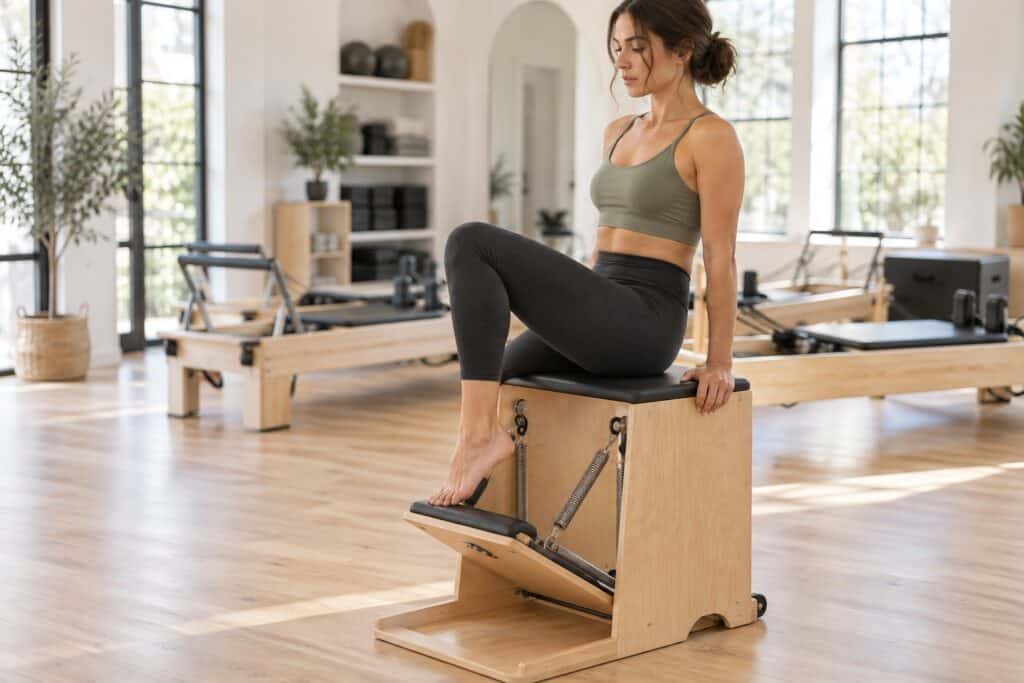
If your studio already runs reformer classes, a Pilates chair is often the next piece of equipment owners look at. It is compact, it costs far less than a Cadillac, and it adds a repertoire that clients find hard but rewarding. This Pilates Wunda chair buying guide covers what the chair is, where it fits next to your reformers and towers, which features matter when you compare models, how to program it into classes, and what to plan for in space and budget before you buy.
What Is the Pilates Wunda Chair?
The Wunda Chair is one of the original pieces of apparatus designed by Joseph Pilates. It is a padded box seat with a spring-loaded pedal on one side. Clients sit, stand, kneel or lie on or beside the chair and press the pedal down against spring resistance, then control it back up. That simple setup hides a big challenge: the base of support is small, so the body has to stabilize itself without the guidance a reformer carriage provides.
Today you will see the chair sold under several names: Wunda chair, combo chair, split-pedal chair or simply Pilates chair. The design details vary between manufacturers, but the idea is the same. Small footprint, heavy springs, and an exercise library that leans toward strength, balance and control.
Why studios add a chair
- Progression for experienced clients. Clients who have been doing reformer classes for a while get a fresh challenge without you having to reinvent your timetable.
- Functional strength. Standing and stepping exercises translate well to everyday movement, which suits seniors, athletes and post-rehab clients.
- Space efficiency. A chair fits in floor space that could never hold another reformer.
- New class formats. Chair-only, circuit or “reformer + chair” sessions give you something different to market.
Chair vs Reformer vs Cadillac: Where It Fits in the Equipment Lineup
Each apparatus does a different job. We compare the larger pieces in detail in our reformer vs tower vs Cadillac guide. Here is how the chair fits alongside them:
| Apparatus | Main strength | Footprint | Best role in a studio |
|---|---|---|---|
| Reformer | Versatile full-body work on a moving carriage | Long, roughly bed-sized | The core of group classes and most private sessions |
| Tower / Cadillac | Supported spring work, push-through bar, trapeze (Cadillac) | Tall; the full Cadillac is large and permanent | Privates, rehab-focused work, advanced repertoire |
| Wunda chair | Strength, balance and stability on a small base | Compact, fits in a corner | Progressions, circuits, small-group and private work |
The chair is not a replacement for a reformer. For most studios the reformer stays the main purchase, and the chair is what you add once your reformer room is running well. Think of it as the piece that makes an existing room more useful, not the one you build a studio around.
Home buyers: is a chair a good first piece?
For some people, yes. If space is very tight, a chair gives a serious workout in a footprint smaller than a desk. But it is less forgiving than a reformer, and many exercises are best learned with an instructor first. If you are still choosing your first home machine, read our 2026 home reformer buying guide before deciding.
Key Features to Look For in a Wunda Chair
Chairs look similar in photos, but small details change how they feel in class. Compare these points when you shop.
Spring tension and spring changes
Springs are the heart of the chair. Check how many spring settings the chair offers, how heavy the strongest setting is, and how quickly an instructor can change them between exercises. In a group setting, a slow or fiddly spring change breaks the flow of class. Also check whether replacement springs are easy to buy, because springs wear out and need replacing over the life of the chair.
Pedal design
A single wide pedal is stable and simple. A split pedal lets each leg or arm work independently, which exposes imbalances and adds reciprocal exercises such as alternating presses. Many modern “combo” chairs can be used both ways. Also look at pedal grip, how smoothly the pedal moves, and whether it can be locked in place for safe mounting and dismounting.
Noise and smoothness
Chairs used in group classes get a lot of repetitions. Bearings on the pedal axle and coated spring hooks make the chair quieter and smoother, which matters in a busy studio and for home users with neighbours.
Dimensions, weight and build
Measure height, width and depth, and check the weight if you plan to move chairs around for different class formats. A chair that is too light can shift during standing work. A solid frame and a stable base matter more than looks.
Padding and comfort
Clients kneel, sit and lie on the seat, so the upholstery needs to be firm, comfortable and easy to clean between sessions.
Example: the Combo Chair III
To make this concrete, here is how the Combo Chair III we sell stacks up against the checklist above. It is Align-Pilates’ latest version of the Wunda chair, with a cushioned seat, a set of springs and foot pedals that can be used for core, upper body, lower body, balance and flexibility work.
- Dimensions: 25″ H × 22″ W × 32″ D (64 × 55 × 82.5 cm)
- Weight: 84 lbs (38 kg)
- Build: maple-veneered marine ply on a steel frame
- Quiet operation: pedal locking mechanism, revised pedal axle with roller bearings, rubber-coated silent spring hooks and a chromed spring tree
- Replacement springs: 47 cm Strong (Green) and Very Strong (Red) springs are sold separately
Best Wunda Chair Exercises for Class Programming
The chair repertoire is large. These classic exercises are a practical starting point for building class blocks. As always, choose spring settings and progressions based on each client’s level.
Lower body and footwork
- Seated footwork: heels, toes and single-leg presses to warm up legs and feet, just like reformer footwork.
- Standing leg press: standing beside the chair and pressing the pedal with one foot. Great for single-leg strength and balance.
- Mountain climb / step-ups: stepping onto the seat while controlling the pedal. A functional favourite for athletes and active seniors.
Core and full body
- Pike: hands on the pedal, lifting the hips. Demanding core and shoulder work.
- Teaser on the chair: a classic balance and core exercise performed on the seat.
- Swan on the chair: lying prone over the seat and pressing the pedal with the hands to open the chest and strengthen the back.
Upper body
- Triceps press / dips: sitting or facing away from the chair, pressing the pedal with the hands.
- Push-down variations: standing behind the chair and pressing the pedal for shoulder and arm strength.
Programming ideas
- Reformer + chair circuits: rotate clients between reformers and chairs every 8–10 minutes.
- Chair-only small group: four to six chairs in a small room for a focused 45-minute class.
- Private progression: use the chair in privates to build the balance and strength clients need for harder reformer work.
- Warm-up station: standing leg presses before class to wake up legs and feet. Our warm-up and cool-down routines pair well with this.
Because the base is small, the chair is less forgiving than a reformer. Teach mounting, dismounting and pedal control before you run fast-paced flows, and keep beginners on lighter, seated work at first.
Space and Budget Considerations for Studios
Floor space
The chair itself is compact, but clients need room around it. Many exercises have them standing beside, behind or in front of the chair, or extending arms and legs past the frame. As a rule of thumb, leave clear space on all sides so instructors can move between clients and spot them. If you are planning a full room, our guide to reformer room layouts for 8–12 beds shows how circulation space adds up. Chairs often fit in leftover corners or a smaller second room.
Ceiling height
Standing exercises and step-ups lift clients well above floor level. Check ceiling height and any low fixtures above the spot where the chair will go.
Budget
A chair costs much less than a reformer or Cadillac, which is why it is a popular second purchase. At the time of writing, the Combo Chair III is listed at CA$1,900 (US$1,500), with replacement springs from CA$60 each. Prices can change, so check the product page for current pricing in your currency. When you budget, include:
- The chairs themselves, one per client for chair classes
- Spare springs, so a worn spring never takes a chair out of service
- Freight and delivery to your location
- Instructor training time on the chair repertoire
How many chairs do you need?
For privates and circuits, one or two chairs are often enough. For dedicated chair classes, plan one chair per client. Many studios start with two, test demand with circuits and privates, and add more once chair classes fill up. For a wider view of studio purchases, see our Pilates studio equipment guide.
FAQ
What is the difference between a Wunda chair and a combo chair?
“Wunda chair” is Joseph Pilates’ original name for the apparatus. “Combo chair” is the name many manufacturers use for modern versions whose pedal setup can be used in more than one way. Both do the same job: spring-loaded pedal work on a compact seat.
Is the Wunda chair good for beginners?
It can be, with guidance. Seated footwork and simple presses suit beginners. Standing, balancing and inverted exercises are better saved until clients have good control, ideally learned with an instructor.
How much space does a Pilates chair need?
The Combo Chair III measures 22″ wide by 32″ deep, but plan for clear space around it for standing and extended exercises and for instructor movement.
Should a studio buy a chair or another reformer?
If your reformer classes are often full and you have the floor space, another reformer adds capacity. If you want new class formats, better progressions or you only have a small leftover space, a chair is usually the better buy.
How often do chair springs need replacing?
It depends on how much the chair is used. Check springs regularly for stretching, gaps between coils or damage, and keep spares on hand. Our weekly studio maintenance checklist can help you build this into your weekly routine.
Find the Right Chair for Your Studio
A Wunda chair adds strength, balance and variety to your studio without taking up much space. If you want help choosing a chair or planning how it fits alongside your reformers, contact the Go Align Pilates team or view the Combo Chair III.