
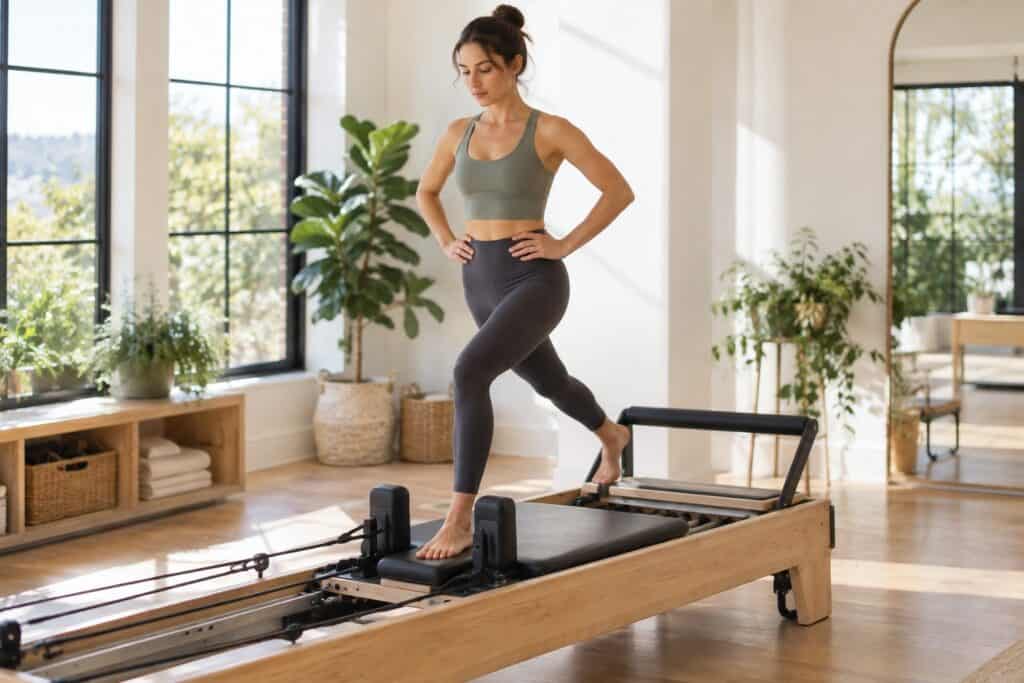
A good Pilates session doesn’t start with the hundred and it doesn’t end the moment you step off the carriage. The few minutes on either side of your workout decide how well your body performs and how it feels the next morning. This guide gives you a simple Pilates warm up routine and a matching cool-down you can do on any reformer, at home or in the studio, plus how to adjust both for beginner, intermediate and advanced classes.
Both routines take about five minutes each, use light spring settings, and follow the same principles you’ll hear from experienced instructors: move slowly, breathe deliberately, and wake up the deep stabilizers before you ask them to work hard.
Why a Pilates Warm-Up Routine Matters
Pilates looks gentle, but reformer work loads your joints through long ranges of motion against spring resistance. Going into that cold is how people tweak a lower back during short spine or strain a hamstring in a deep lunge.
Injury prevention
A warm-up gradually raises muscle temperature and increases blood flow, which makes muscles and connective tissue more pliable. Your joints also produce more synovial fluid as they move, so hips, shoulders and the spine glide more freely once you’re warm. That matters on a reformer, where a moving carriage asks for control at the end of your range.
Muscle activation and mind-body connection
The real goal of a Pilates warm-up isn’t sweat; it’s connection. You want your transverse abdominis, pelvic floor and multifidus switched on before the bigger muscles take over. Slow, focused movements also shift your attention from your inbox to your body, which is where Pilates does its best work. If you’re new to the method, our guide to reformer Pilates for beginners explains these core principles in more detail.
5-Minute Reformer Pilates Warm-Up Routine
Set the reformer to a moderate spring load (for most machines, two to three medium springs) unless your instructor suggests otherwise. Keep the headrest up if you have neck sensitivity.
1. Breathing and imprint (45 seconds)
Lie on the carriage with knees bent and feet on the footbar. Inhale into the back and sides of your ribs, then exhale and gently draw your navel towards your spine, feeling the low back soften toward the carriage. Repeat five to six breaths. This sets the breathing pattern you’ll use for the rest of class.
2. Pelvic tilts and bridging prep (1 minute)
From the same position, exhale and tilt the pelvis so the tailbone curls slightly up, then inhale back to neutral. After six tilts, peel the spine up one vertebra at a time into a small bridge and roll back down. Keep the carriage still; if it moves, your legs are pushing instead of your glutes and hamstrings working.
3. Footwork series (2 minutes)
Footwork is the classic reformer warm-up because it moves every joint in the leg while challenging core stability. Do eight to ten slow reps of each position, pressing out on an exhale and returning with control:
- Heels on the bar (parallel) to activate glutes and hamstrings
- Toes on the bar (Pilates V) for calves and inner thighs
- Wide second position for the adductors and hips
- Calf raises at full extension: lower heels under the bar, then rise
4. Arm circles with straps (1 minute)
Lower to one light spring. Hold the straps with arms reaching to the ceiling and legs in tabletop or feet on the headrest. Circle the arms down, out and back up five times, then reverse. Keep the ribs heavy and shoulders away from your ears. This warms the shoulder girdle before rowing, chest expansion or long-box work.
5. Spinal articulation (30 seconds)
Sit up and finish with two or three slow seated roll-downs: curl the spine back toward the carriage and stack it up again. You’re now ready for the main workout.
5-Minute Reformer Pilates Cool-Down Routine
The cool-down brings your heart rate down, restores length to the muscles you just loaded and returns the nervous system to a calmer state. Stay on light springs throughout.
1. Spine stretch forward (1 minute)
Sit tall on the carriage facing the footbar with legs extended slightly wider than hip-width. Inhale to grow tall; exhale and round forward, reaching toward the bar while drawing the belly in. Roll back up on the inhale. Repeat four times, staying soft in the neck.
2. Mermaid side stretch (1.5 minutes)
Kneel or sit sideways on the carriage with one hand on the footbar. Exhale and push the carriage away as you reach the other arm overhead, creating a long arc through the side body. Add a gentle rotation toward the bar on the third rep. Do three to four reps per side. Mermaid is one of the best stretches for the lats, obliques and the quadratus lumborum, which tighten during side work and rowing.
3. Hamstring and hip flexor release (1.5 minutes)
Lie on the carriage with one foot in a strap and lift the leg toward the ceiling for a supported hamstring stretch. Hold for four slow breaths each side. Then stand beside the reformer with one knee on the carriage and the other foot on the floor for a gentle hip flexor stretch, keeping the pelvis tucked.
4. Breathing to finish (1 minute)
Lie back with knees bent. Take five long breaths: inhale for four counts, exhale for six. A longer exhale nudges the body toward its rest-and-recover state, so you leave class feeling energized rather than wired.
Warm-Up Variations for Different Class Levels
The structure stays the same, but the load and complexity should match the class.
Beginner
Stick to the routine above with slower tempos and fewer reps. Replace the strap arm circles with arm reaches on the mat if the straps feel unstable. The priority is learning neutral spine, imprint and coordinated breathing.
Intermediate
Add single-leg footwork, prancing (alternating heel lifts) and a set of hundreds in tabletop with light straps to raise heat. You can also add a short bridge series on the footbar to prime the posterior chain for lunges and long stretch.
Advanced
Advanced classes often move straight into flow work, so the warm-up should include more spinal mobility: add rolling like a ball, cat stretch on the long box and a few slow elephant reps to open the hamstrings and posterior chain. Keep springs moderate; the aim is to prepare, not fatigue.
Common Pilates Warm-Up Mistakes to Avoid
- Skipping it. Arriving late and jumping into the main series is the most common reason people feel strain in the neck or low back.
- Using springs that are too heavy. Heavy springs during footwork encourage locking the knees and gripping with the hip flexors. Start moderate and progress.
- Rushing the reps. Speed hides compensation. Slow reps with a full exhale build real control.
- Holding the breath. If you notice yourself bracing without breathing, reduce the load or range until breath and movement coordinate again.
- Static stretching first. Long holds belong in the cool-down. Before class, favour dynamic, controlled movement.
- Working on a poorly set-up machine. Worn springs, a sticky carriage or a footbar at the wrong height change how every exercise feels. If your equipment is due for an upgrade, see our Pilates reformer buying guide for home use.
If you have ongoing back discomfort, pair these routines with the gentle progressions in our article on Pilates for back pain, and check with your healthcare provider first.
FAQ
How long should a Pilates warm-up be?
Five to ten minutes is enough for most people. Longer sessions or advanced classes benefit from the full ten minutes, especially early in the morning or in a cold room.
Can I do a Pilates warm-up routine without a reformer?
Yes. Breathing, pelvic tilts, bridging, arm circles and roll-downs all work on a mat. Footwork can be replaced with slow squats or heel raises standing at a wall.
Is footwork really a warm-up or part of the workout?
Both. On moderate springs and at a controlled tempo it’s an ideal warm-up. On heavier springs with single-leg variations it becomes strength work.
Do I need to cool down after a short home session?
Even a 20-minute session benefits from two or three minutes of stretching and breathing. It helps you feel less stiff the next day and reinforces good posture.
What’s the best spring setting for warming up?
It depends on your machine and body, but most people start footwork on moderate resistance and use one light spring for arm work. Your instructor or your reformer’s user guide can give machine-specific recommendations.
Make Every Session Count
A consistent Pilates warm up routine and cool-down add only ten minutes to your practice, but they protect your joints, sharpen your technique and make the work in between far more effective. Build them into every session, whether you’re on a home reformer or teaching a full studio class.
Setting up a home studio or outfitting a new space? Our team can help you choose the right reformer, springs and accessories for your goals. Contact Go Align Pilates today.