
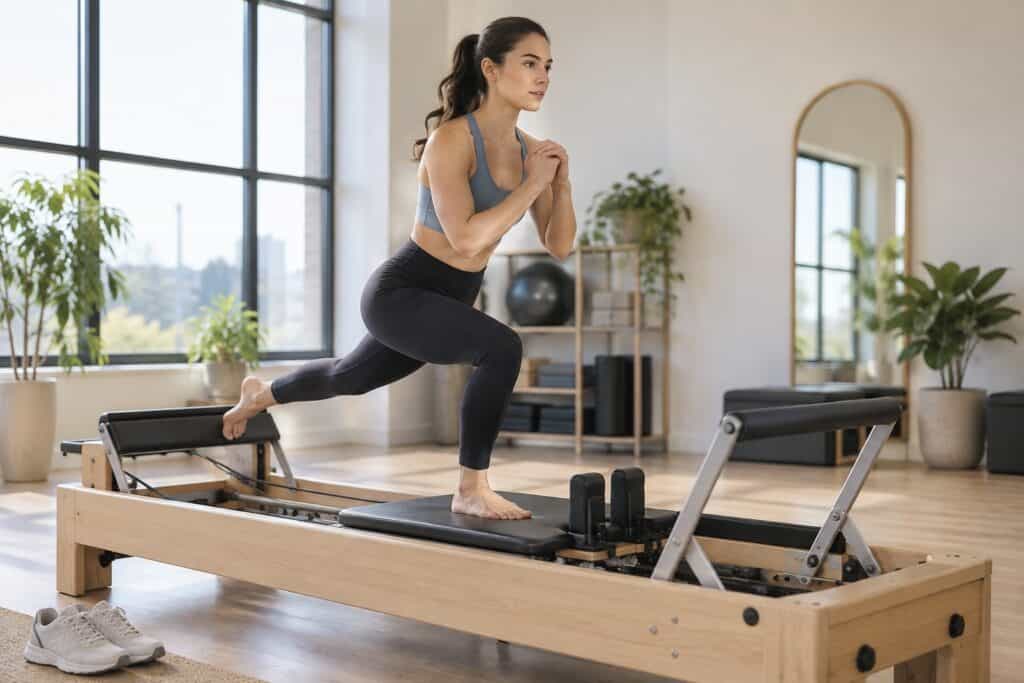
Running is simple: lace up and go. That simplicity is also its weakness. Every stride repeats the same forward motion thousands of times, and over months the body adapts by getting very good at one pattern while the muscles that stabilize the hips, pelvis and ankles quietly fall behind. Pilates for runners fills that gap. Reformer training builds the deep core control, single-leg stability and mobility that running alone rarely develops, which is why more coaches and physiotherapists now recommend it as a regular part of a training week.
This guide explains why runners benefit from Pilates, the reformer exercises that matter most, how to structure pre-run and post-run sessions, how to fit Pilates into a training plan, and which common running injuries it can help you avoid.
Why Runners Need Pilates
Running is a single-leg sport. At every footstrike, one leg absorbs a load of roughly two to three times your body weight while the pelvis, trunk and ankle work to keep you balanced. If any link in that chain is weak or stiff, the load shifts somewhere it shouldn’t.
Muscle imbalances
Most runners have strong quads and calves and comparatively weak glutes, hamstrings and deep abdominals. The result is a stride that leans on the front of the leg and the lower back. Pilates deliberately trains the posterior chain and the transverse abdominis — the muscles that hold the pelvis level — so that force is shared more evenly.
Hip stability
When the gluteus medius can’t control the pelvis, the opposite hip drops and the knee collapses inward with each step. That pattern is linked to IT band pain, runner’s knee and shin problems. Side-lying and standing reformer work strengthens the lateral hip under controlled spring resistance, which is far more targeted than simply running more miles.
Ankle and foot mobility
Stiff ankles shorten the stride and push stress up into the knee and Achilles. Reformer footwork moves the ankle through its full range under load, building both mobility and strength in the calf and foot — the area that takes the first hit on every landing.
Key Reformer Exercises for Runners
The reformer is especially useful for runners because the springs provide adjustable resistance in both directions, and the moving carriage forces you to stabilize. If you’re new to the machine, start with our guide to reformer Pilates for beginners before adding the exercises below.
Footwork series
Lying on your back with feet on the footbar, press the carriage out and back with heels, arches and toes. Add calf raises (heel lowers and lifts) at full extension. This mirrors the push-off phase of running while keeping the pelvis neutral, and it strengthens the calves eccentrically — a proven way to protect the Achilles.
Single-leg footwork
Repeat the series one leg at a time. Watch the knee track over the second toe and keep the pelvis from rocking. Any side-to-side difference you notice here usually shows up in your stride too.
Leg circles and frog in the straps
With feet in the straps, draw controlled circles and frog presses. These open the hips, train the adductors and hamstrings through a long range, and teach the core to stay still while the legs move — exactly what you need when fatigue sets in late in a run.
Bridging on the footbar
Feet on the bar, lift the hips and press the carriage out and in while holding the bridge. This loads the glutes and hamstrings together and builds endurance in the posterior chain. Progress to single-leg bridges once you can hold a level pelvis.
Side-lying leg press and standing side splits
Both target the gluteus medius and the inner thigh. Standing side splits also challenge balance in a way that closely resembles single-leg stance in running.
Long stretch and knee stretches
These plank-based exercises build anti-extension core strength and shoulder stability, which helps you hold posture and arm swing through the final kilometres.
Pre-Run vs Post-Run Pilates Routines
Pilates can be used both as preparation and as recovery. The difference is intensity and intent.
Before a run (10–15 minutes)
- Light-spring footwork to warm up ankles and calves
- Bridging to switch on the glutes
- Leg circles in the straps for hip mobility
- A short set of knee stretches to engage the core
Keep the springs light and the reps moderate. The goal is activation, not fatigue. A short reformer warm-up like this is often more effective than static stretching before a run.
After a run (15–20 minutes)
- Slow, full-range footwork to flush the calves
- Hamstring and hip flexor stretches using the straps or the carriage
- Spine mobility work such as mermaid side bends
- Gentle frog and circles to restore hip range
Post-run sessions should feel restorative. Use the springs for support and focus on breathing and length rather than strength.
How Pilates Complements Your Running Training Schedule
Pilates works best as a supporting session, not a replacement for running. A practical structure for most recreational runners:
- Two strength-focused reformer sessions per week (30–45 minutes) on easy-run or rest days
- Short activation sessions before quality workouts such as tempo runs and intervals
- Recovery-focused sessions the day after a long run
Avoid heavy single-leg reformer work the day before a race or key workout. During peak mileage weeks, reduce Pilates intensity rather than dropping it entirely — maintaining hip and core strength is what keeps you healthy when volume is high. In the off-season, you can increase Pilates to three sessions per week to correct imbalances before the next build.
Runners who also play rotational sports such as golf or tennis can borrow ideas from our article on Pilates for rotational athletes, which covers trunk rotation and anti-rotation work.
Common Running Injuries Pilates Can Help Prevent
Most running injuries are overuse injuries — they come from repeating a slightly faulty pattern thousands of times. Pilates doesn’t replace medical treatment, but it addresses many of the strength and control deficits behind them.
Runner’s knee (patellofemoral pain)
Often linked to weak hips and poor knee tracking. Single-leg footwork and side-lying work build the control needed to keep the knee aligned.
IT band syndrome
Typically connected to a dropping pelvis and weak gluteus medius. Lateral hip strengthening on the reformer is one of the most useful preventive tools.
Achilles tendinopathy and calf strains
Eccentric heel lowers in the footwork series load the tendon progressively, which helps it tolerate running forces.
Shin splints
Better ankle mobility and stronger foot and calf muscles reduce the stress on the shin. Pairing reformer work with sensible mileage increases is key.
Lower back pain
Many runners feel their lower back on long runs as the core fatigues. Our guide to Pilates for back pain explains how reformer exercises build the deep trunk support that keeps the spine comfortable mile after mile.
FAQ: Pilates for Runners
How often should runners do Pilates?
Two sessions per week is enough for most runners to see changes in hip stability and core strength within six to eight weeks. Short activation routines before key runs are a useful bonus.
Is reformer Pilates better than mat Pilates for runners?
Both help. The reformer adds adjustable spring resistance and an unstable carriage, which makes it easier to progress strength and to train single-leg control. Mat work is convenient for travel and days without equipment.
Will Pilates make me a faster runner?
Pilates doesn’t replace speed work, but better hip stability, stronger glutes and a more efficient posture reduce wasted motion. Many runners notice improved form late in races, when fatigue normally breaks technique down — and staying injury-free is the biggest factor in getting faster over a season.
Can I do Pilates on the same day as a run?
Yes. Light activation work before a run and recovery work after are both appropriate. Save harder strength sessions for easy-run or rest days.
Do I need a reformer at home?
Not necessarily, but a home reformer makes it much easier to stay consistent around a training schedule — especially for short pre-run activation sessions.
Bring Pilates Into Your Running Week
Pilates for runners is about building the parts of the body running neglects: the deep core, the lateral hip, the posterior chain and the ankle. Add two reformer sessions a week, use short routines before and after key runs, and you’ll give yourself the best chance of training consistently and running stronger through the whole season.
Thinking about adding a reformer at home or in your studio? Contact the Go Align Pilates team and we’ll help you choose equipment that fits your space and training goals.